
10 facts about underwater inspections
Underwater inspections are needed in many industrial plants – from sprinkler tanks, fire water and process water tanks to cooling water basins and intake structures. With underwater drones (ROVs), these inspections can be carried out without divers and without draining. The following ten facts show what underwater inspections by drone can do and where their limits lie.
Underwater inspection with ROVs and micro-ROVs: no divers, no draining
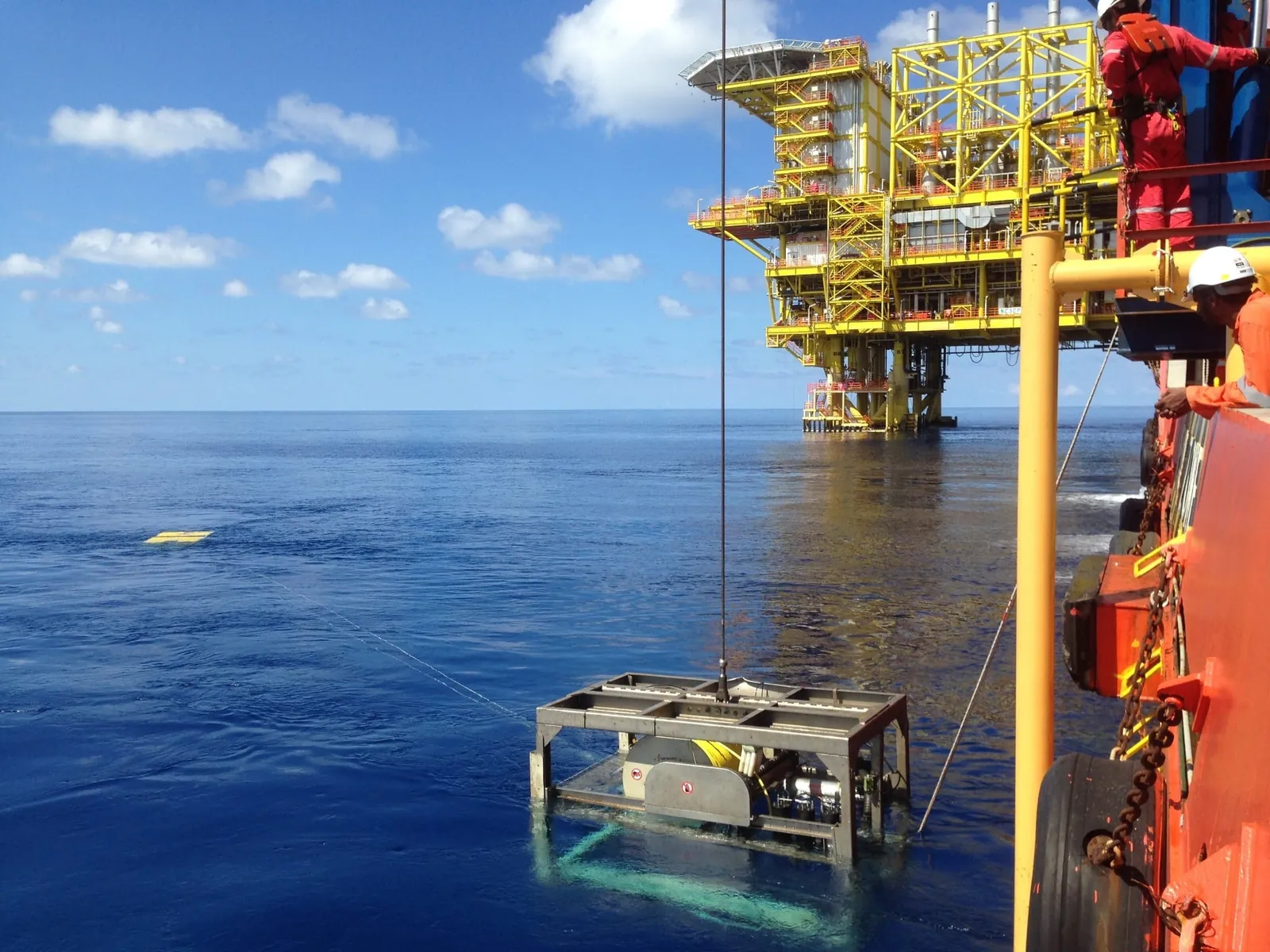
Underwater inspections are increasingly carried out with ROVs (remotely operated vehicles) and micro-ROVs, as they offer considerable advantages over traditional methods. ROVs allow accurate and safe inspections in environments that would be too dangerous or hard to reach for human divers. Micro-ROVs, which are even more compact, can also be used in very confined spaces such as pipelines or small vessels. These drones are ready for use after a short set-up time and deliver high-resolution images in real time. They also stir up less sediment, which improves visibility. Using ROVs and micro-ROVs not only saves costs but also minimises risks and environmental impact, which makes them the obvious method for tanks and basins in industrial plants.
 Dipl.-Wirt.-Ing. (FH) Juliana Engelke
1. ROVs: no diver has to enter the tank
In the past, underwater inspections of tanks and basins were mostly carried out by divers, which involved considerable risks and high costs. Divers need special safety precautions, elaborate equipment and a team of several people, and in confined vessels or murky water diving is particularly delicate. ROVs (remotely operated vehicles) are a safer alternative that involves less effort. They are remotely controlled underwater drones that do not send anyone into the water and, depending on their equipment, carry cameras, sonar or grippers. For sprinkler and fire water tanks in particular, the tank does not need to be drained and fire protection remains in place. Using ROVs reduces inspection costs considerably, as fewer personnel are needed and the drones can be deployed more flexibly without a dive team.
2. From sprinkler tanks to intake structures: where ROVs inspect
Underwater drones are used in many industries and fields of application. In industrial plants they mainly inspect sprinkler and fire water tanks, cooling water and clarification basins, as well as intake structures and extraction pipes at power stations. Wells, water storage facilities and port installations are also typical places of use. This makes ROVs a useful tool whenever a vessel or basin is not to be drained.
3. High-resolution cameras show damage in detail
ROVs are equipped with high-resolution cameras that allow a detailed visual inspection. Many of these cameras offer 4K resolution, so that even small cracks or corrosion damage become visible. Together with powerful LED lights, ROVs also work in dark tanks that receive no daylight. In very murky water, however, visibility is limited. The camera system plays a central role in documenting the inspection results, as the images and video are transmitted to the surface in real time. This image quality ensures that critical areas are fully documented and can be assessed by your inspectors.
4. Micro-ROVs: inspections in confined spaces
Micro-ROVs are purpose-built underwater drones that are particularly compact and light. They are suited to use in confined or hard-to-reach areas such as pipes, tanks or narrow gaps. Their small size allows them to enter a vessel through manholes and small inspection openings that are too narrow for larger ROVs or divers. Despite their small size, micro-ROVs are equipped with powerful cameras, sonar and sometimes even gripper arms, which makes them an important tool for inspections in hard-to-reach areas. In industrial environments such as water treatment plants or chemical plants, micro-ROVs reduce effort and costs, as no additional access points have to be created.
5. In murky water, sonar shows outlines and distances
One of the biggest challenges in underwater inspections is poor visibility, especially in water made murky by dirt, sediment or algae. ROVs can therefore be fitted with sonar technology, which allows them to navigate and record structures even at zero visibility. Sonar works with sound waves that are reflected by objects and so produce an image of the surroundings. In murky water, a sonar shows the outlines of walls and internal fittings and measures distances; it does not show corrosion or cracks. Sonar technology is particularly useful in basins, intake structures or tanks with deposits, where silt and sediment severely restrict visibility.
6. Live image: you decide while the inspection is still running
A key advantage of current underwater inspection systems is the transmission of data to the surface in real time. The ROV's camera and sensors send their information directly to the pilot. You see the live image during the inspection and can have conspicuous areas examined more closely straight away. This reduces follow-up inspections. Videos, images and, where applicable, sonar data are then available for planning repairs or further measures.
7. Less stirred-up sediment, less disturbance
An often overlooked advantage of ROVs is that they are environmentally friendly. Compared with traditional diving inspections or the use of heavy machinery, ROVs stir up less sediment and disturb the natural underwater environment less. This is particularly important in fire water and process water tanks, where the water is meant to stay clean. The precise control of ROVs makes it possible to work in a targeted way without unnecessarily affecting the surrounding area. Even where hazardous substances or chemicals may be present in the water, nobody has to enter the medium.
8. Dark, murky, confined: where diving is difficult
ROVs are designed to work where deploying people is difficult or dangerous. In tanks and basins, this mainly means darkness, murky water, narrow access openings and internals such as pipes, suction strainers or ladders. They can also be used in contaminated media, such as clarification or cooling water basins, provided the medium and the drone's materials are compatible. The cable connection to the surface transmits the live image and ensures the drone can be recovered.
9. Detecting corrosion and structural damage early
A central aim of every underwater inspection is to detect structural damage early in order to avoid costly repairs or failures. With camera and lighting, ROVs deliver close-up footage of corrosion, cracks, deposits and damaged coatings. The high-resolution, located images cover the visual inspection and show where targeted testing on the component is worthwhile, such as an ultrasonic wall thickness measurement. This testing and the assessment of the findings are carried out by your expert assessors at the points marked in the inspection report. Detecting such damage early is essential to minimise safety risks and extend the service life of underwater structures.
10. The future: artificial intelligence and autonomous ROVs
Underwater inspection is developing towards artificial intelligence (AI) and autonomous functions. Manufacturers and research projects are working on ROVs that plan their own routes, avoid obstacles and automatically mark anomalies in the footage. In tanks and basins, experienced pilots still control the drone today. In future, AI can help to find findings more easily in large volumes of images.
No divers, no draining – fire protection stays ready
Underwater drones make the inspection of sprinkler and fire water tanks, as well as basins and intake structures, considerably simpler: no divers, no draining, and the fire water supply remains available. You receive an inspection report with photos, videos and anomalies with their location in the tank (wall, height, fitting), on the basis of which your inspector decides. If you would like to have a tank or basin inspected, write to us by email or via the contact form. More on the inspection of sprinkler and water tanks.