
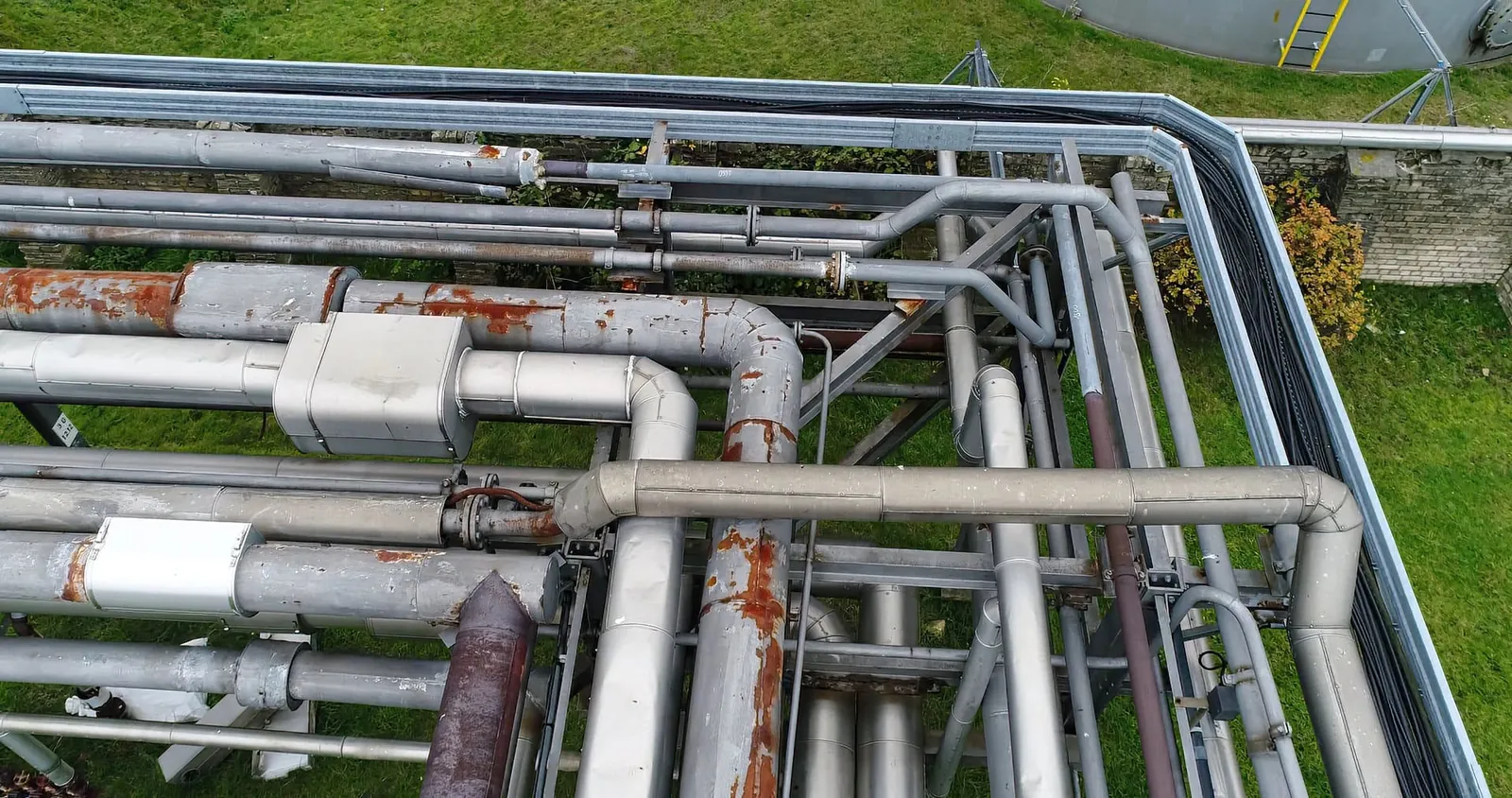
The 10 most common types of damage to pipe racks – and how drones make inspection easier
Pipe racks connect the parts of industrial plants – they carry media and energy to where they are needed. They are under constant load: wind and weather, thermal stress and mechanical impact all take their toll. Regular inspection of these widely branched and hard-to-reach structures used to involve considerable effort. Conventional inspection methods require scaffolding, aerial work platforms or rope access. Inspection drones offer an alternative here. They deliver detailed footage from the air – without scaffolding and without work at height for personnel. With high-resolution cameras and thermal imaging they reveal damage early, before it becomes a serious problem. Read how drone inspections support the maintenance of pipe racks and where their limits lie.
Inspect pipe racks without scaffolding over site roads and plant
In industrial plants, pipe racks form a widely branched network. They carry liquids, gases and other media across the entire site. Because they run over site roads, plants and buildings, even gaining access for an inspection involves considerable effort.
Drones open up new possibilities here: for the overview from the outside we use the DJI M30T with zoom and thermal cameras, and between closely spaced pipe layers the collision-tolerant ELIOS 3. They deliver detailed footage without scaffolding, aerial work platforms or rope access technicians, and operations continue during the external flight.
In this article we show the ten most common types of damage to pipe racks, how drone inspections reveal them early and where the limits of visual and thermal inspection lie. More on industrial inspection.
 Christian Engelke
1. Corrosion under insulation (CUI)
Corrosion under insulation (CUI) is one of the most serious and at the same time hardest-to-detect types of damage on pipe racks. CUI occurs when moisture penetrates the insulation and attacks the surface of the pipes. This type of corrosion often goes unnoticed at first, as it remains hidden under the insulation and so weakens the structure of the pipes undetected.
Causes:
- Water ingress through damaged or inadequate insulation
- Condensation caused by moisture and alternating heat and cold
- Damage to the insulation from mechanical impact or UV radiation
Drones help to narrow down suspected CUI locations without having to remove large areas of insulation. With a thermal camera they record temperature differences on the surface of the insulation that may indicate moisture ingress. This only works if there is a sufficient temperature difference between the medium and the surroundings, and it shows moisture, not the corrosion itself. Whether and how badly the pipe is affected is clarified by targeted testing at the marked points. The pipe does not have to be stripped of insulation along its entire length.
2. Mechanical damage from shocks and vibration
Pipe racks are exposed to constant mechanical loads from vibration and shocks caused by environmental influences such as wind, traffic or the operation of machinery. Over time, these mechanical effects can lead to structural weakening in the form of cracks, deformation or material fatigue.
Causes:
- Strong vibration from the operation of heavy machinery
- Wind and environmental influences
- Pressure surges and pulsating flows in the pipes
Drones record cracks and deformation on pipelines and supporting structures at close range. With high-resolution cameras and 3D scans, the condition of the structure can be documented and compared over several inspections. The located footage covers visual inspection and damage mapping and shows where targeted testing on the component is worthwhile for very fine or concealed cracks. This reduces the risk of serious damage and production losses.
3. Weather damage from UV radiation, heat and frost
Pipe racks are permanently exposed to the elements. Over time, UV radiation can damage protective coatings and insulation, while sharp swings between heat and cold fatigue the material and can lead to cracks and deformation. These continuous environmental loads contribute significantly to the deterioration of the infrastructure.
Causes:
- Direct sunlight and UV radiation that damage materials
- Sharp swings between heat and cold that drive the expansion and contraction of materials
- Moisture and precipitation that promote corrosion
Drones make it possible to monitor pipe racks regularly and comprehensively by capturing high-resolution images and thermal images of hard-to-reach areas. This data allows weather-related damage to be monitored continuously before it leads to serious problems.
4. Foundation problems and settlement
Settlement of the foundation or ground movement are serious problems that can jeopardise the stability of the entire pipe rack. These movements of the subsoil are often caused by changes in the ground, erosion or undersized foundations.
Causes:
- Ground movement due to erosion, flooding or soil compaction
- Inadequate foundation design
- Natural events such as earthquakes or heavy rainfall
Drones with high-resolution cameras and 3D capture provide aerial images of foundations and supports, revealing visible changes such as cracks, tilting or washouts. Precise settlement measurements still require a geodetic survey. These images allow continuous monitoring and help to detect settlement or displacement early, before greater damage occurs.
5. Impact damage to supports and impact protection
Pipe rack supports often stand directly beside site roads, loading zones and manoeuvring areas. Lorries, forklifts or mobile cranes can strike supports, impact protection and base plates – resulting in deformation, spalling on the concrete plinth or loosened anchorages.
Causes:
- Lorries, forklifts or mobile cranes striking supports in cramped areas of the site
- Missing or damaged impact protection
- Construction work and material transport near the pipe rack
After an impact, drones can be deployed at short notice by arrangement to document the supports, the impact protection and the pipe layers above them. The external flight takes place while the plant is running, and your expert assessors receive a basis for their assessment promptly. No scaffolding is needed to record the damage.
6. Fatigue cracks from repeated loading
Fatigue cracks result from cyclic loads to which pipe racks are exposed through heating and cooling or repeated vibration. These cracks develop gradually but worsen over time and can eventually lead to serious damage.
Causes:
- Repeated loads from heating and cooling
- Vibration from machinery or pumps acting continuously on the structure
- Wind or weather loads that cause long-term weakening
Drones with high-resolution cameras reveal fatigue cracks on welds, brackets and supports as soon as they are visible on the surface. Regular inspections make it possible to detect cracks in good time, before they lead to dangerous leaks or structural weakness.
7. Damaged or worn insulation
The insulation of pipelines and racks protects the pipes from environmental influences, reduces energy losses and prevents moisture from penetrating the structure. Over time, however, this insulation can be impaired by UV radiation, mechanical damage or simple wear.
Causes:
- Ageing of the insulation material due to UV radiation, heat and frost
- Mechanical damage from vibration or impact
- Moisture penetrating through cracks in the insulation
Drones can be used to find damaged or worn insulation without scaffolding: the camera shows open joints, cracks and missing cladding, and the thermal image shows heat losses – depending on the temperature difference between the medium and the surroundings. This allows damage to be repaired before larger problems such as CUI develop. Regular checks maintain the insulating effect and reduce repair work in the long term.
8. Corrosion from aggressive chemicals in the ambient air
In industrial environments, the air can often contain aggressive chemicals that attack the surface of the pipes and accelerate corrosion. This type of chemical corrosion occurs particularly in heavily industrialised areas and considerably shortens the service life of pipe racks.
Causes:
- High concentrations of sulphur or nitrogen oxides in the air
- Direct contact with chemicals from industrial processes
- Chemically aggressive environments in refineries or chemical plants
Drones with high-resolution cameras can be deployed regularly to document visible corrosion on pipes, supports and steelwork. How far the wall thickness has decreased is measured by the expert assessor, for example by ultrasound, specifically at the points marked in the inspection report. These regular inspections prevent more extensive corrosion damage and extend the service life of the structure.
9. Leaks at joints, seals and expansion joints
Joints and seals are particularly susceptible to wear and material fatigue. Leaking joints can lead to escapes of liquids or gases, which not only impair the operation of the plant but also pose considerable safety and environmental hazards.
Causes:
- Thermal or mechanical loads that weaken joints
- Ageing and wear of sealing materials
- Faulty installation or inadequately sized seals
Drones can carry out inspections in hard-to-reach places and, using thermal and zoom cameras, provide indications of leaks at joints and seals, such as escaping media, discolouration or anomalies in the thermal image. The camera does not detect gas escapes that leave no visible traces and cause no temperature difference. This allows problems to be rectified in good time, before they lead to costly failures or environmental damage.
10. Damage to bearings, sliding supports and pipe supports caused by thermal expansion
Pipelines expand when they heat up and contract when they cool down. This movement is taken up by sliding supports, anchor points and pipe supports. If a sliding support seizes, a pipe moves beyond its support or a bracket bends, restraint stresses arise in the pipe and the steel structure.
Causes:
- Sliding supports seized by rust or dirt
- Pipes that have moved beyond their support or slipped off it
- Bent, loosened or torn-off pipe supports and brackets
Drones with a zoom camera show the position and condition of bearings, anchor points and supports at close range, even in the middle of wide pipe racks. Comparing several inspections reveals whether pipes have shifted. This allows bearings and supports to be repaired before the pipe or steel structure is damaged.
Monitor pipe racks without scaffolding or work at height
The inspection of pipe racks is an important part of maintenance – it keeps the plant working and contributes to environmental protection, operational safety and occupational safety. Whereas traditional inspection methods involve work at height, scaffolding and considerable effort, drones open up ways of monitoring plants without scaffolding or work at height.
Using inspection drones improves several aspects at once:
Occupational safety: instead of sending people to dangerous heights or into hard-to-reach areas, the drone takes the footage – without risk to people.
Operations and costs: external flights over pipe racks take place while the plant is running. Scaffolding and aerial work platforms are not needed, and the inspection takes hours instead of days. Your inspection costs can fall by up to 80% because scaffolding, cranes and rope access technicians are not needed. Where a shutdown is necessary, the drone keeps it short. The image data allows more targeted maintenance planning.
Environmental protection: early detection of corrosion damage, material fatigue or potential leaks makes it possible to reduce environmental risks in advance.
The high-resolution footage, located in the 3D point cloud, covers visual inspection and damage mapping. It also shows where targeted testing on the component is worthwhile, such as an ultrasonic wall thickness measurement where concealed corrosion is suspected. This testing and the assessment are carried out by your expert assessors at the points marked in the inspection report. We fly – Inspectomatic, the reporting arm of our group of companies, analyses the data and produces the inspection report in the browser: located findings, photos, videos and a 3D point cloud; for more background see pipe rack inspection on inspectomatic.de (in German). In hazardous (Ex) areas, the operator decides whether the drone may fly. More on inspection with the ELIOS 3.