
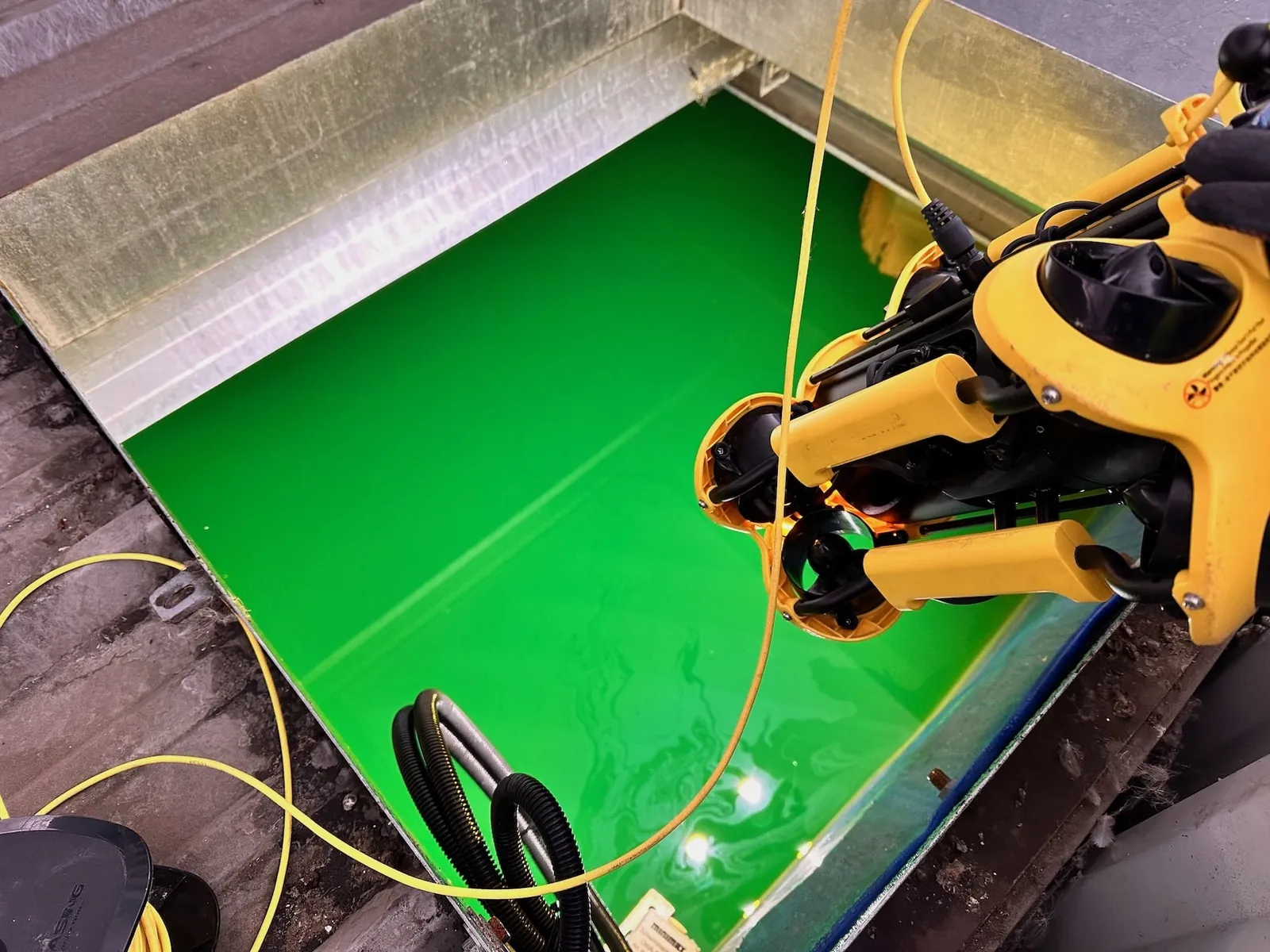
Micro-ROV vs diver: 7 advantages of underwater drones
Micro-ROVs are a safe alternative to diving operations and to draining installations. They manoeuvre in confined spaces, stir up less sediment than divers and are easy to clean. A deployment requires considerably less preparation than a diving operation and delivers high-resolution footage. In this article you will learn the 7 most important reasons why micro-ROVs replace divers in many underwater inspections.
No divers, no pumping out: where micro-ROVs (underwater drones) replace diving operations
Traditional inspections of underwater infrastructure often rely on divers or on draining the installation. While divers are still needed for many complex tasks underwater, micro-ROVs are a cost-effective alternative for inspections and for recovering tools or foreign objects. These small, remotely operated vehicles take on many tasks that would otherwise require elaborate operations. In this article we look at the 7 most important reasons for this.
 Dipl.-Wirt.-Ing. (FH) Juliana Engelke
1. No need to drain the installation
Traditional inspection methods often require installations or vessels to be pumped out before inspections or repairs can be carried out. This process is not only time-consuming but also leads to long interruptions to operations and higher costs. Micro-ROVs make pumping out unnecessary, as they can operate directly in liquid-filled installations. Draining and refilling are not needed. Particularly in areas such as tanks, reservoirs or pipelines, micro-ROVs offer a low-effort solution, as they can carry out detailed imaging and inspections without the tank having to be taken out of service or water drained off. With sprinkler tanks, the fire water supply remains available.
2. No divers in hazardous environments
Using divers in industrial environments often involves considerable risks. In confined or hard-to-reach spaces such as tanks or reservoirs, diving operations can be dangerous. Extensive safety precautions have to be taken, such as providing additional personnel and emergency equipment and following strict protocols. Micro-ROVs avoid these risks because nobody has to enter the water for the inspection. They can operate safely in cramped spaces that are inaccessible or too risky for divers, delivering detailed footage as they do so.
3. Simpler cleaning than with diving equipment
Where the water is to stay clean, for example in fire water or process water tanks, all equipment has to be cleaned before use. Diving equipment has to be extensively cleaned and disinfected for this; micro-ROVs can be cleaned with much less effort and are ready for use without complex procedures. In addition, the compact design of micro-ROVs means that they can manoeuvre in cramped vessels without contaminating the water.
4. Less sediment disturbance for clearer inspections
Divers easily stir up sediment on the floor of the tank or reservoir with their fins and movements. This sediment impairs visibility and makes an accurate inspection more difficult. Micro-ROVs, by contrast, create considerably less turbulence as they move through the water and so stir up less sediment. This gives a clearer view of the areas to be inspected and makes it possible to capture detailed and meaningful data. Visibility therefore stays clear for longer during the inspection. If the water itself is very murky, however, this also limits the ROV's camera.
5. Navigation at zero visibility with sonar
Many industrial installations have areas where visibility is severely restricted or non-existent – whether due to murky water, dirt deposits or complete darkness. This is where micro-ROVs show their strengths, as they can be fitted with sonar that allows them to navigate safely even at zero visibility. With sonar, micro-ROVs detect obstacles, measure distances and make their way to the areas that need to be inspected. Sonar is used for orientation and shows outlines; surface details are provided only by the camera when visibility is sufficient.
6. Flexible deployment with little preparation
Deploying divers or draining an installation often requires long and complex advance planning – with a risk assessment, additional personnel and extensive equipment. A micro-ROV deployment is much simpler to prepare: the equipment fits into a few cases and the team is small. We agree the date with you, which also makes it easier to schedule inspections needed at short notice. Operations are hardly disrupted.
7. Footage your inspector can base decisions on
Another major advantage of micro-ROVs is their ability to capture high-resolution underwater images and videos. ROVs are equipped with powerful cameras that deliver clear and detailed footage even in poor lighting. This footage forms the basis for documenting damage or wear. In addition, many micro-ROVs can be fitted with sonar or a gripper arm, for example to recover foreign objects. Learn more on our page on the inspection of sprinkler tanks and water tanks. The footage covers the visual inspection and shows where targeted testing on the component is worthwhile, such as a wall thickness measurement. This is carried out by your expert assessor at the points marked in the inspection report.
Less effort than pumping out or sending in divers – the tank stays in service
Micro-ROVs are a safe, low-effort alternative to pumping out installations or deploying divers. They require less preparation and fewer safety precautions and work even in poor visibility or confined spaces. Filled tanks remain in operation, and the equipment is easy to clean. This makes underwater inspections shorter, safer and less expensive. You can read how we go about this on our page on inspection by underwater drone.